







Presidents Cup 2026: 11 Consecutive Defeats – Is It Time to Change the Game?

1. When Defeat Becomes More Than Just One Bad Week
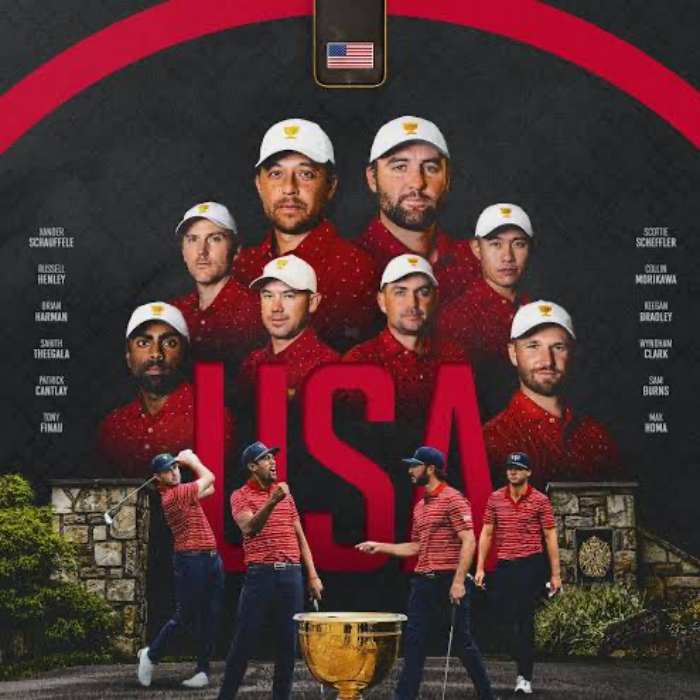
The 2026 Presidents Cup at Medinah Country Club concluded with a 17–13 victory for the United States. Yet the final score hardly tells the full story.
The International Team had established a commanding 7–3 lead after the opening two days and maintained a 10.5–7.5 advantage heading into Sunday’s singles.
They needed just five more points from the remaining 12 matches to end a losing streak stretching back nearly three decades.
Instead, the Americans won nine singles matches, halved one and lost only two, producing a remarkable comeback.
It marked the United States’ 11th consecutive Presidents Cup victory, extending a run of dominance that began in 2005.
What makes the result particularly frustrating is that the International Team was hardly short of world-class talent.
Hideki Matsuyama, Adam Scott, Si Woo Kim, Tom Kim and Min Woo Lee are all capable of competing against the very best. Individually, any of them can defeat an American opponent on a given day.
But the Presidents Cup is not decided by individual brilliance alone.
It is a contest involving 12 players across 30 matches and three different formats. A team may possess several outstanding golfers, but without sufficient depth and consistency throughout its roster, it remains vulnerable when the competition reaches the singles session.
That is precisely the structural challenge the International Team continues to face.
2. Is the Problem Player Quality or the Selection Structure Itself?
Statistics published by Golf Digest ahead of the 2026 Presidents Cup reveal a significant shift in the distribution of elite golfing talent.
When the competition began in 1994, the world’s top 20 included eight International players, seven Americans and three Europeans.
By 2026, that balance had changed dramatically.
Distribution of golfers in the world’s top 20
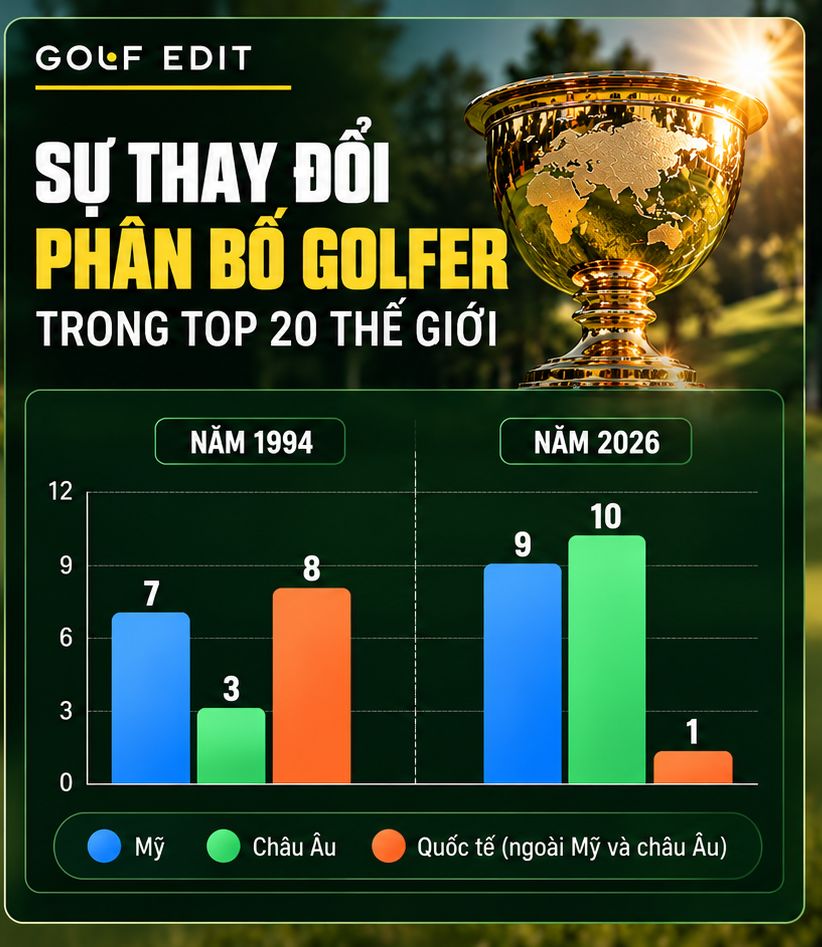
Figures cited by Golf Digest. The 1994 figures do not account for all 20 ranking positions.
These figures are revealing.
World golf does not lack elite players outside the United States. The problem is that a substantial proportion of them are European and therefore ineligible to represent the International Team.
Under the current eligibility rules, the International Team can only select players from outside the United States and Europe.
Six players qualify automatically through the Official World Golf Ranking (OWGR), while the remaining six are selected by the captain.
Consequently, the International Team competes against the United States with a restricted talent pool from the outset.
While the Americans can draw upon a deep domestic professional golf system, the International Team must assemble its strongest possible lineup from Australia, Japan, South Korea, South Africa, Canada, South America and other regions.
A team may have several stars at the top of its roster but still lack depth in the remaining positions. That weakness can become particularly apparent during the 12 singles matches.
Interestingly, dividing world golf into three separate groups — the United States, Europe and the International Team — creates two different competitions in which the Americans face opponents drawn from separate talent pools.
At the Ryder Cup, the United States faces Europe.
At the Presidents Cup, the United States faces the rest of the world, excluding Europe.
The question is whether this structure still reflects the distribution of talent in modern professional golf.
3. The Ryder Cup Lesson: How Structural Reform Changed History
The Presidents Cup is not the first team competition to experience prolonged dominance by one side.
The Ryder Cup once faced a similar problem.
Established in 1927, the Ryder Cup originally featured the United States against Great Britain. The opposing team later expanded to include Ireland, but continued to struggle against American strength for decades.
From the end of World War II until the 1979 restructuring, the United States dominated the competition.
The emergence of outstanding players from continental Europe, particularly Spain’s Seve Ballesteros, helped drive a landmark change.
In 1979, the Ryder Cup officially expanded the Great Britain and Ireland team into Team Europe.
The change did not immediately produce victory. The Americans still won in 1979 and 1981.
However, Europe now had access to a broader talent pool and gradually developed a team capable of competing on equal terms.
In 1985, Europe defeated the United States at The Belfry, ending the Americans’ winning streak.
Two years later, Europe secured another victory, this time on American soil.
By 1995, Europe had developed a distinct team identity, with players such as Seve Ballesteros, José María Olazábal, Nick Faldo and Bernhard Langer helping establish a foundation for future generations.
The lesson from the Ryder Cup is not simply that adding stronger players improves a team.
It demonstrates how expanding the selection pool, improving competitive balance and establishing a shared identity can transform a competition into a sustainable global sporting event.
Today, the Ryder Cup attracts audiences not only because of its star players, but also because of its tradition, rivalry and the belief that either team can produce a historic victory.
There is a lesson here for the Presidents Cup.
4. Should the Presidents Cup Allocate Two or Three Places to European Players?
This is a proposal worth discussing.
Geographically, Europe is unquestionably part of the world outside the United States. Yet under the existing structure, it is excluded from the Presidents Cup because of its separate participation in the Ryder Cup.
That arrangement makes historical sense, but it does not necessarily mean the Presidents Cup must preserve it indefinitely.
One possible reform would be to retain the International Team’s 12-player roster while allowing two or three European golfers to participate.
Proposed Expanded International Team
Players outside the U.S. and Europe

A Golf Edit proposal for discussion, not an officially announced PGA Tour policy.
The inclusion of a small number of European players could produce three important changes.
First, greater roster depth. The final positions would no longer depend entirely on the existing International talent pool. The captain would gain additional options based on current form, course suitability and match-play ability.
Second, improved pairing flexibility. European golfers with Ryder Cup experience could introduce new combinations in foursomes and four-ball, particularly alongside players from Asia or Australia.
Third, greater commercial appeal. The presence of European stars could broaden the competition’s international audience, enhance broadcasting value and create new high-profile rivalries.
Imagine an International Team featuring Hideki Matsuyama, Si Woo Kim, Adam Scott and Min Woo Lee, supplemented by European players such as Rory McIlroy, Tommy Fleetwood or Ludvig Åberg.
That would be a very different-looking lineup.
Naturally, these names are illustrative rather than an official selection proposal.
5. But Opening the Door to Europe Creates New Challenges
Such a change cannot be considered solely from a competitive perspective.
The Ryder Cup and Presidents Cup are both biennial competitions, staged in alternating years.
Allowing European players to participate in both events could increase the demands on leading golfers already balancing PGA Tour, DP World Tour and major championship commitments.
More importantly, the Ryder Cup possesses its own distinctive identity.
If the Presidents Cup opens its doors too widely to European players, it risks becoming a second version of the Ryder Cup rather than preserving its independent character.
There is also the question of opportunity.
Adding three European golfers would mean three fewer places for players from other regions.
That is a significant consideration for developing golf markets such as South Korea, Japan, South Africa, Canada and South America.
The Presidents Cup remains one of the few elite team competitions where golfers from outside the United States and Europe can represent their regions on a global stage.
An excessive focus on improving immediate competitive balance could inadvertently reduce opportunities for the very markets the competition was designed to represent.
Therefore, expanding the International Team should not mean abandoning its identity.
A limited allocation of two or three European places, combined with measures protecting opportunities for other regions, could provide a framework for experimentation.
6. LIV Golf: Another Factor Affecting Competitive Balance
Beyond geography, the Presidents Cup must also confront the fragmentation of professional golf.
Players such as Cameron Smith, Joaquin Niemann, Lucas Herbert and Marc Leishman remain outside the current selection pool because of restrictions associated with LIV Golf.
International captain Geoff Ogilvy has acknowledged the impact of being unable to select these players.
The United States also loses potential options, including Bryson DeChambeau. However, its greater roster depth provides more alternatives.
For the International Team, losing even one elite player can create a significant gap.
Before introducing European players, the organizers should therefore also consider a selection system based more directly on competitive merit rather than membership of a particular tour.
The Presidents Cup cannot fully reflect the strength of world golf if a substantial group of elite players remains ineligible.
7. Are 11 Consecutive Defeats Damaging the Presidents Cup’s Appeal?
This may be the most important question for the competition’s commercial future.
A successful team sporting event requires three essential ingredients: star power, rivalry and uncertainty of outcome.
The Presidents Cup still possesses the first two. But the third is increasingly challenged by history.
Across 16 editions, the United States has recorded 14 victories, one defeat and one tie.
The International Team’s only victory came in 1998 at Royal Melbourne. Prolonged dominance does not automatically destroy a competition’s value. However, it can influence audience expectations.
A compelling contest needs to create a genuine sense that both sides have a chance of winning.
The 2026 Presidents Cup achieved precisely that during its opening three days. The International Team led, spectators witnessed closely contested matches, and the championship remained undecided until the final day.
Yet the paradox remains: even when the International Team performs exceptionally well, the United States still emerges victorious.
If this pattern continues, the competition’s long-term appeal could come under increasing pressure.
Fans do not watch sport simply to admire outstanding shots. They also want stories, turning points, upsets and historic breakthroughs.
That is exactly what the Ryder Cup has successfully cultivated since expanding Team Europe.
8. The Solution Goes Beyond Adding Two or Three Europeans
Expanding the roster could improve player quality, but it would not resolve every problem facing the International Team.
Golf Digest has highlighted how the declining representation of non-American, non-European golfers among the world’s elite is also connected to player development systems, professional pathways and access to the PGA Tour.
Young golfers increasingly move directly into the American college system or U.S.-based developmental tours rather than progressing through domestic professional structures.
This may affect the development of future generations in Australia, South Africa and other regions.
A broader Presidents Cup reform could therefore address four areas.
Limited expansion: Experiment with two or three European places while retaining the majority of positions for players outside the United States and Europe.
Broader eligibility: Consider allowing elite golfers from different professional tours to participate under transparent performance-based criteria.
Long-term development: Strengthen connections between the Presidents Cup, junior golf programs, regional tours and player development initiatives across Asia, Australia, Africa and South America.
Competition format review: Examine the distribution of foursomes, four-ball and singles matches to support competitive balance without artificially favoring either team.
However, the rules should not be changed simply to guarantee an International victory.
A balanced competition does not require an equal distribution of titles. What matters is that both teams have reasonable selection and competitive conditions, allowing results to be determined by performance on the course.
9. Presidents Cup 2028: An Opportunity for a New Chapter
The Presidents Cup will return to Australia in 2028, with Kingston Heath Golf Club hosting the competition.
This provides an opportunity for organizers to undertake a comprehensive review of the current model.
From a sports business perspective, maintaining the existing structure or expanding eligibility should be evaluated against three objectives: competitive quality, tournament identity and long-term commercial value.
If an expanded model is introduced, organizers could begin with a limited trial, assessing changes in roster quality, competitive balance and audience response before considering permanent implementation.
Crucially, the interests of golf federations and players from the International Team’s traditional regions must be protected.
The Presidents Cup is more than a contest between star players. It also represents the development of golf beyond its two traditional power centers: the United States and Europe.
Golf Edit Perspective: The Presidents Cup Must Become More Than a Statistical Exercise
Eleven consecutive defeats cannot be explained solely by missed putts, questionable pairings or one disappointing singles session.
They reflect several accumulated factors: disparities in roster depth, geographical restrictions, changes in the professional golf landscape and differences in player development across regions.
The Ryder Cup’s transformation in 1979 demonstrates how changing a team’s structure can have a profound impact on the future of a competition.
But it also shows that meaningful change takes time.
The Presidents Cup now faces a similar choice: preserve its traditional structure or explore an expanded model that better reflects the modern distribution of golfing talent.
Two or three places for European players represent one possible option for discussion.
At the same time, broader eligibility across professional tours and greater investment in player development outside the United States and Europe also deserve consideration.
A competition does not need its two teams to alternate victories to remain compelling. But it must offer a contest in which victory for either side is a genuine possibility.
After what unfolded at Medinah in 2026, the debate over the future of the Presidents Cup has moved well beyond the disappointment of a single sporting defeat.
GolfEdit.com





Comments
You must be logged in to comment.