




Why was Rory McIlroy not allowed free relief from a banana peel?
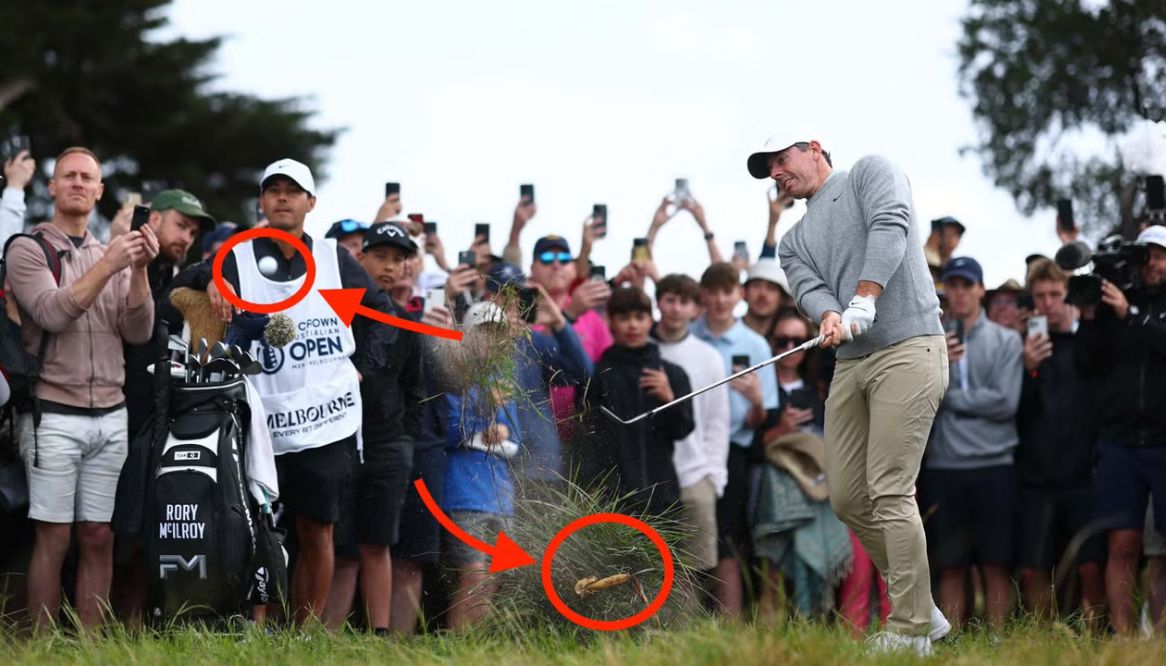
This unusual situation happened to Rory McIlroy, and the immediate question rose:
“Is Rory entitled to free relief?”
To answer that, we must go straight to the essence of the rulebook and understand why something as trivial as a banana peel can dramatically change how a golfer must handle the situation.
1. Understanding the Core Issue
In the Rules of Golf, proper classification of the object interfering with play determines whether relief is allowed. The USGA divides such objects into two categories:
a. Loose impediments — Natural, unattached objects
Examples: leaves, twigs, detached grass, small stones.
Key principle: You may remove them.
But if the ball moves while doing so, you incur a one-stroke penalty.
b. Movable obstructions — Artificial objects that can be moved
Examples: water bottles, scoreboards, broken tees, trash bins.
Key principle: You may remove them freely.
If the ball moves, no penalty—the ball is simply replaced.
So, where does a banana peel fit?
2. A banana peel — funny in appearance, serious in the rulebook
Putting emotion aside, a banana peel is not artificial.
It is natural, even if it certainly does not belong on Royal Melbourne. That means it is not a movable obstruction—it is classified as a loose impediment.
This leads to a crucial rule:
If Rory touched the banana peel and his ball moved, he would be penalized one stroke.
That is why McIlroy didn’t call for a ruling. He understood the nature of the situation:
A banana peel is a loose impediment, and it is pressing against the ball. If I try to pick it up, the ball will almost certainly move. I’m not taking that risk.
Elite players process rules extremely quickly during competition. Rory chose to play the ball as it lay—not because it was easy, but because it carried the lowest risk.
3. Why can’t a banana peel be treated like a water bottle?
Many amateurs mistakenly think, “If it’s trash, just remove it.”
But golf rules do not operate on emotion or appearance.
There are many natural objects you cannot claim free relief from, such as: animal droppings, dead animals, spider webs, snow or natural ice
A banana peel falls into the same category: natural, non-artificial, and not eligible for free relief.
4. The result: a very “fruity” shot — and a double bogey
Rory was forced to hit from the awkward lie. The peel flew everywhere, the shot didn’t come out cleanly, and the sequence resulted in a double bogey.
A literal “banana split,” but not the kind anyone wants.
What stands out is McIlroy’s response:
He birdied the very next hole and added five more birdies in his final 10 holes, finishing with a 68 (-3) that day.
A perfect demonstration of mental resilience:
Your response matters more than the mistake itself.
Key lessons from Rory’s banana-peel incident
Not every piece of “trash” qualifies for free relief — the distinction between natural and artificial is essential.
Before removing a loose impediment, evaluate the risk: if the ball might move, you risk a penalty.
Sometimes the safest play is simply to take the difficult shot as it lies.
Handling adversity calmly is more important than the adversity itself.
5. Golf is rarely boring — even when a banana peel becomes part of the story
McIlroy’s season has featured its share of unusual moments, and this banana-peel episode at Royal Melbourne is yet another addition. But episodes like this remind us:
Golf is not only technique—it is rules, decision-making, and emotional control.
And sometimes… it is about a banana peel showing up at exactly the wrong moment.
GolfEdit.com


Comments
You must be logged in to comment.