





L4–L5: The spinal segment that nearly ended Tiger Woods’ career
🎧 Listen to podcast: Tiger Woods và 7 lần phẫu thuật lưng
Duration: 3:52 • Source: Golfcasts.com
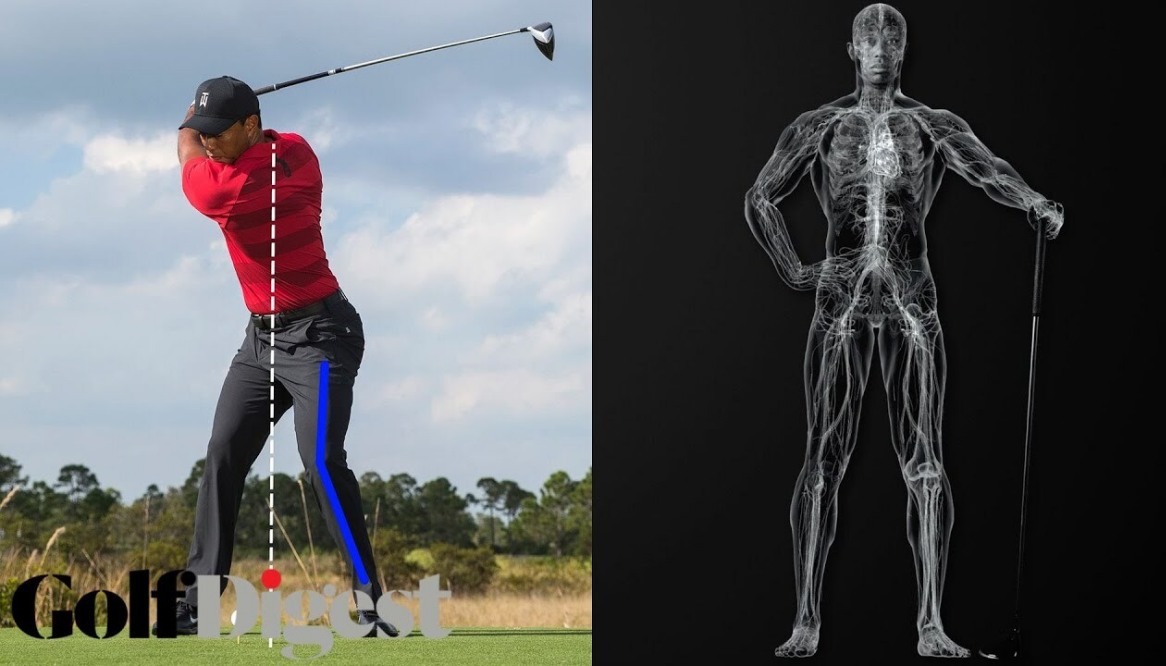
When Woods stepped up to the podium to announce his latest procedure — a disc replacement at the L4–L5 level — the golf world sighed once again. It marked the seventh back surgery since 2014.
For a player who once redefined efficiency and durability through his swing, every incision on his lower back is not just a medical act — it’s a deep cut into his game, his technique, and his legacy.
L4–L5: The load-bearing crossroads of the human spine
The human spine has 33 vertebrae — the foundation of the body’s structure. Among them, the five lumbar vertebrae (L1–L5) bear almost all the upper body’s weight. The space between L4 and L5 is the crucial “load center,” where rotational, compressive, and lateral forces converge every time a golfer swings.
For Tiger Woods, this L4–L5 region has become the epicenter of his pain, especially after his 2017 L5–S1 spinal fusion.
When one spinal segment is fused, the level above must absorb the extra stress — a biomechanical reality known as adjacent segment overload.
At swing speeds over 125 mph, the compression force on Woods’ L4–L5 disc can exceed seven to eight times his body weight. Over time, that disc degenerated: collapsing, tearing, pressing on nerve roots — until replacement with an artificial disc became inevitable.
A Surgical Odyssey: From herniation to disc replacement
Tiger’s path to healing is a timeline of scalpels and recovery beds.
April 2014: First back surgery — a microdiscectomy at L5–S1 to relieve nerve compression.
September 2015: Recurrent disc issues required a second procedure.
October 2015: A third follow-up operation to address post-surgery pain.
Three procedures in 18 months — and Tiger missed the entire 2016 season, sending shockwaves through golf.
Then came the pivotal April 20, 2017 fusion surgery, where the damaged L5–S1 disc was removed and the two vertebrae fused. It ended his crippling nerve pain — and, astonishingly, led to his triumphant 2019 Masters victory.
But that victory carried a hidden cost. The fused joint shifted immense pressure upward, turning L4–L5 into the next casualty zone.
Between 2020 and 2025, Tiger entered a new surgical cycle:
2020: Microdiscectomy at L4–L5 to remove loose fragments.
2024: Nerve decompression at the same level.
October 2025: Full L4–L5 artificial disc replacement.
Each surgery required 6–9 months of recovery, meaning Tiger has lost nearly one-third of his prime years to healing his spine.
When the golf swing becomes a gamble
For Woods, a swing isn’t just a movement — it’s instinct, art, identity. But his spine is now part metal, part biology — fused in one section, replaced in another.
Biomechanics experts explain that the golf swing’s combined rotation, tilt, and compression create immense torque around the L4–L5 area. When discs lose their natural elasticity, those forces rebound through the hips and knees, demanding a total reconstruction of his swing mechanics:
Shorter backswing to reduce spinal torsion.
Greater upper-body and hip engagement to generate speed safely.
Less spine tilt at impact, producing a flatter, more controlled flight.
Shorter follow-through to minimize reactive strain.
Tiger has transformed from the supple, explosive “big cat” of the 2000s into a controlled warrior, where every swing is a biomechanical equation measured to the millimeter.
Not alone in pain
The lower back has long been the Achilles’ heel of rotational athletes.
Jason Day missed half a PGA Tour season with an L4–L5 herniation, narrowly avoiding surgery.
David Duval, a former world No.1, never recovered his form after chronic lumbar issues.
In tennis, Andy Murray endured hip and disc surgeries and nearly retired before returning with an artificial implant.
In basketball, Dwight Howard’s 2012 herniated disc surgery permanently altered his explosiveness.
But no athlete in elite sport has endured seven back surgeries and continued to compete with such willpower and obsession as Tiger Woods.
His fight is no longer for trophies — it’s a testament to human perseverance when the body itself becomes the greatest adversary.
The Cost: scheduling and psychological weight
Since 2020, Woods’ presence on Tour has become rare, almost ceremonial. He’s no longer a fixture on the PGA Tour, but a revered guest appearing only at majors or his own foundation events. His schedule isn’t measured in tournaments, but in the long silences between them.
Each appearance requires precise recovery planning — weeks of light training, physiotherapy, and cautious buildup — followed by painful recovery. Every decision to compete is a calculated risk, often traded for weeks of post-event suffering and potential re-injury.
This has destroyed the rhythm that defines professional golfers — the momentum forged by constant play, the feel sharpened by weekly competition.
For Tiger, that lost rhythm is the invisible cost — the erosion of sharpness that once made him untouchable.
At his peak, he relied on a superhuman body to dominate. Now, every appearance is a battle to find lost tempo inside a frame rebuilt with steel and scar tissue.
The psychological battlefield
Beyond the physical pain lies a far heavier burden: the mind. Each surgery is not just a procedure — it’s an encounter with fear. Each awakening from anesthesia marks another uncertain beginning.
Woods has admitted, “I had to learn to trust my body again.” That isn’t just humility — it’s trauma.
Every reherniation, every nerve flare, fractures that fragile trust. The subconscious learns to fear the swing that once defined him. Sports psychologists call it kinesiophobia — the fear of re-injury — a silent, merciless enemy.
Athletes like Tiger subconsciously restrict motion, avoiding full rotation, reducing hip speed, limiting explosive movement. Measured in numbers, this fear steals 5–10% of clubhead speed and 15–20% of hip rotation — a chasm in a sport where millimeters decide victory.
The result is a swing that is no longer instinct and freedom, but a negotiation — between muscle memory, fear, and the immovable laws of physics.
Tiger Woods’ greatest battles are no longer fought on the fairways or greens. They happen within his own spine — and his own mind — every single day. Each time he steps onto a tee box, it isn’t merely a golf shot. It’s a moment of defiance, a confrontation with his own limits, and perhaps the most profound act of courage in modern sport.
GolfEdit.com


Comments
You must be logged in to comment.